

After a hectic day at the market, she returned home with her son, Clement, for a well-deserved rest on the mat she had laid on the floor of their wooden house built on water. While she was still fast asleep, Clement woke up, crying. Probably he was hungry. But, she didn’t hear him. When she eventually woke up, she could not find her baby boy by her side.
Ahonsu had thought one of his uncles had come to pick him up. She later realised this was not the case. A search party was subsequently raised to unravel the mystery surrounding the boy’s disappearance.
Unknowingly to her, Clement had fallen into the murky waters a few feet below them. There was no way he could swim. He was seven-month-old.
His corpse was found 30 minutes later by an inconsolable group and a distraught mother when they looked through a hole on the wooden floor. All efforts to revive him failed. The little boy had drowned in the water underneath his parent’s house in Makoko, Yaba Local Council Development Area, Lagos.
“Earlier, my mother had called me to ask if I heard my baby cry, and I had replied, ‘yes,’ but I said that unconsciously from my sleep,” she recollected, with obvious pain.
The hole has since been covered up, but the one inside her heart still remains. “He’s gone and there is nothing I can do about that, I cannot follow him to the grave. I have not yet recovered from the loss, he was my only child,” she told PUNCH.
Now, the rate of teenage pregnancies in Makoko is still one of the major problems facing the predominantly riverine community, writes Arukaino Umukoro.
Aged 19 when she first got pregnant, Ahonsu is still learning to deal with the tragic past. But the present reality for many in Makoko, a peaceful and sometimes bustling riverine community, where their major occupation is fishing and trading, is lack of education and high rate of teenage pregnancies.
Since their forefathers migrated from neighbouring Francophone West African countries like Togo and Benin Republic, as well as from Badagry, Lagos, most of the children in the community neither speak nor understand English. They speak their local Egun dialect and sometimes French.
Findings show that many girls in Makoko find themselves drowning in the waters of unplanned pregnancy.
A 2008 statistics from the World Bank put the percentage of teenage mothers in Nigeria, aged 15-19 who have had children or are currently pregnant, at 23 per cent. Low education levels have also been closely linked with early childbearing.
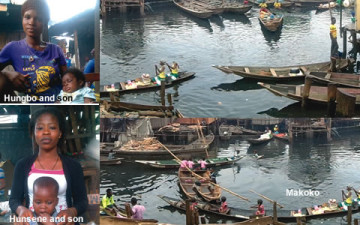
For example, 19-year-old Suzanna Hunsene, never had proper schooling and does not know how to speak English. She had her first child at 16, but now she said her 23-year-old husband, who works as a carpenter fixing tiles in houses in the city, wants a divorce.
“He doesn’t love me anymore but I am also ready to divorce him,” she said, and mentioned her 15-year-old friend who was not married but already has a one-year-old child.
She isn’t aware of the issues surrounding teenage pregnancy, but told our correspondent that she just wanted to get on with her life. “I wished I went to school. But now I want to learn tailoring to help me and my son and to take care of his future,” she told PUNCH.
She wants her three-year-old son, Ayomide, who is nicknamed ‘Baddo’, like popular Nigerian artiste Olamide, to become a lawyer in future. “We are suffering here in Makoko. But if he becomes a lawyer, he will be able to defend us against any planned demolition,” she said.
Over a year ago, the Lagos State Government had demolished some houses in Makoko, which it said constituted an environmental nuisance, security risk and a barrier to the economic use of the waterfront.
19-year-old Owolabi Hungbo, still unmarried, had her first child when she was 18. She also expressed regrets for not acquiring an education, pointing out that the lack of education and not listening to the advice of their parents and elders were major impediments to the development of young girls in her community.
“We need to have more schools here and the government can help provide vocational training centres for girls to learn a trade so that they will have something that can earn them a living and keep them busy. Many young girls are idle,” she said.
The lack of any form of infrastructure in densely populated areas such as Makoko has contributed to cases of teenage pregnancies, noted Mrs. Princess Olufemi-Kayode of Media Concern Initiative.
“Teenage pregnancies affect nearly every area, but it is more prominent in densely populated areas and this is due to several environmental and social factors, lack of infrastructural facilities in healthcare and education, and what they are exposed to. So, they may have more social problems than others.
"And if everybody they know is getting pregnant or married at 14, it would be the attraction for the majority of these young girls to also want to become ‘madam’,” Kayode explained.
Twenty-year-old Hannah Hunge, who, like Hungbo, also had her first child at 18, dropped out of school in Senior Secondary School because of her pregnancy.
“I told my parents about it when I discovered I was pregnant and decided to stop schooling. If I have another opportunity, I still want to become a medical doctor. Young girls should go to school or learn a trade,” she said.
Like Hunsene, Hungbo and Hunge, the dreams of many young girls in Makoko have been cut short by teenage pregnancy, bringing another life into the world they never planned adequately for.
“Although I can’t say if the rate of teenage pregnancy is rising in this community, but one thing I know is that we feel ashamed of ourselves whenever we see each other, it’s not a good thing getting pregnant at a young age; you don’t feel good inside,” Hunge said.
In His Reaction to the menace:
The head of the traditional chiefs in the area, 55-year-old Mr. Francis Agoyon Alashe, said the rate of teenage pregnancies in the community was nothing to worry about. “Why should we be worried? We take it as the wondrous and marvellous deed of God, that young girls at 11 or 12-year-old are getting pregnant and giving birth and that a 15-year-old boy can get a girl pregnant. In my days, we were taught that 18 was the ideal age, but times have changed,” he said.
Agoyon has 14 children — 10 boys and four girls. He said, “My first daughter, who is now 29-year-old, got pregnant at 15; the second, who is now 19-year-old, got pregnant at 16. [But] My boys have not impregnated any girl because they are focused on their education.
“Sometimes, Egun people don’t like using condoms. Our argument is, how can you ejaculate into a rubber? There is no pleasure in that. Although common sense says the use of condom could prevent pregnancy, but we don’t need it. We like real sex, even if we give birth to many children, we don’t mind. If, for example, I get married to a 15-year-old girl, it means I will now become a younger looking man,” he said, laughing.

So the Head Chief is banging 15 years girls and he is lagging about it? Another Yerima in Makoko
ReplyDeleteWhy can't that Fashola develop the place. Instead he's busy deceiving people and building so called Atlantic nonsense. Fashola is a fraud.
ReplyDeleteSo if I go to Ghana and start living on dirty water, you expect the Government of Ghana to come and develop the place for me? There is something wrong with your thinking faculty.
DeleteFashola should send all the illegal immigrant back to the Franchophone countries where they all came from.
@last comment try to think wise before comment by saying fashola deceiving people by atlantic the point is if he ready to developed the area can the people who are staying there avoid to pay the rent or did you think this people will be happy with fashola if he did so if he send them away you same people will call him anti masses and for calling him a fraud government by all what he has done what can you call the rest of the state in nigerian i can see you are blind .......easy
ReplyDeletefashola is aware of dis and he is nt doin anyting...coward is he
ReplyDeleteMust you comment if you don't hAve any good thin to say
ReplyDeleteFor a man to be emancipated there is the need to change the orientation of such person. When a whole leader of community or settlement sees nothing wrong in teenage pregnancy then it is very bad.
ReplyDeleteFor the government to help these people there is need for mass orientation on various aspects of their lives, health, social life, education and other things. They are aware of condom but they saw it as obstacle to proper ejaculation. What a life ? So procreation in abject poverty is preferable to them than living a good lives.
Finally, in order to help the youth in this settlement government should try and provide vocational training school where various skills can be acquired.